













For years, planting canola with a row planter meant working around a problem farmers should not have had to accept.
Canola seed is small, expensive, and unforgiving. Every seed matters. But instead of using a disk designed specifically for canola, farmers were often forced to use sugar beet disks and make the best of it.
The problem was simple.
Sugar beet disks were not built for canola.
They could get seed in the ground, but not always with the accuracy, speed, or consistency growers needed. Singulation was inconsistent. Planting speeds had to stay slower. Parts wore faster. And in some cases, seed was being pulled into the vacuum, creating uneven spacing and wasted seed.
For a crop where seed cost and stand consistency matter so much, “close enough” was not good enough.
Two Farmers Saw the Problem Differently
Kerry Cadieux and Jeff Calder knew there had to be a better way.
They were not trying to reinvent planting just for the sake of building something new. They were trying to solve a real problem farmers were already dealing with in the field.
The available options were forcing growers to compromise:
- Slow down to reduce seed loss
- Accept uneven spacing
- Deal with excess wear
- Plant more seed than necessary to protect stand counts
- Hope the final crop evened out by harvest
That is a lot of compromise for one small seed.
So Kerry and Jeff designed a disk specifically for canola instead of forcing canola to work through a disk built for another crop.
What Made the RRV Canola Disk Different
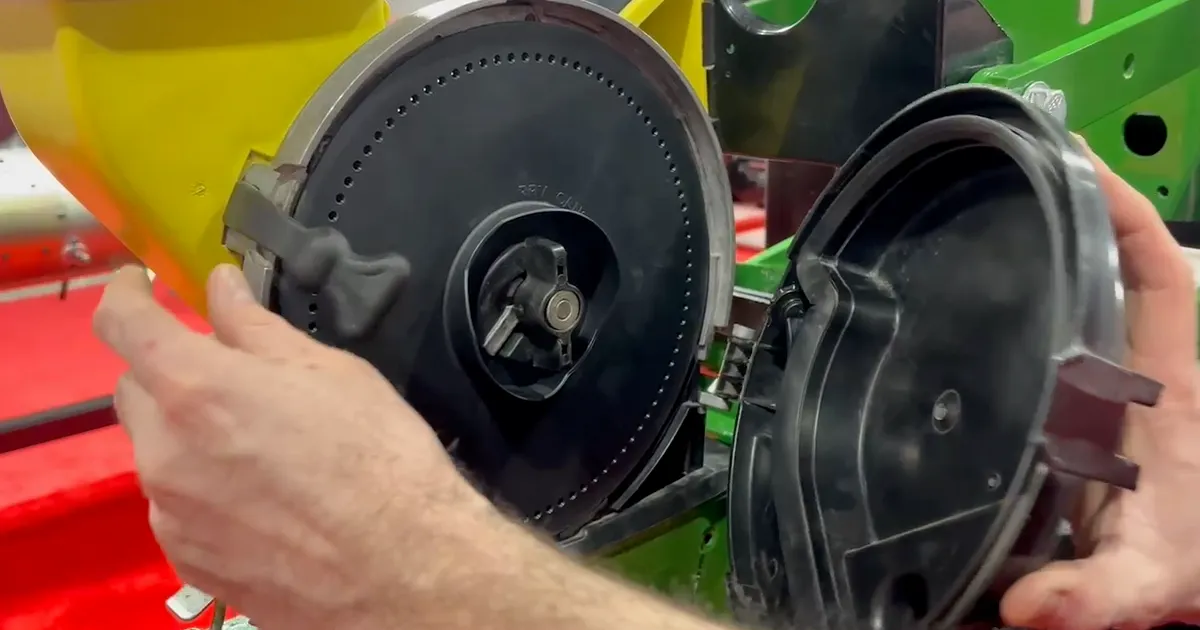
The RRV Canola Disk was designed around the size and behaviour of canola seed.
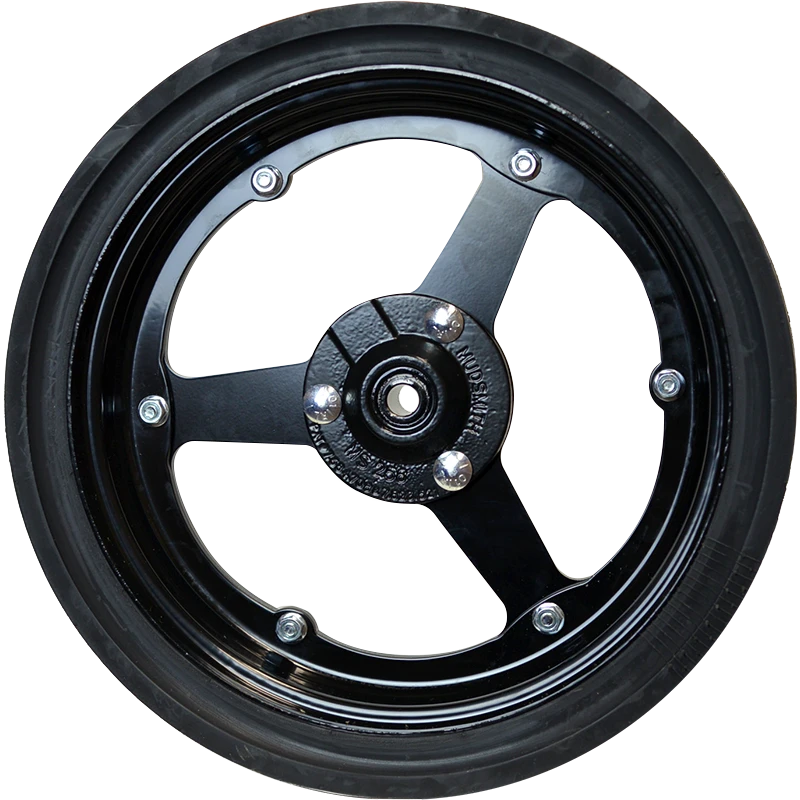
Instead of relying on a sugar beet disk, the RRV Canola Disk uses 90 cells, which is double the number of cells in many sugar beet disk setups. That higher cell count allows growers to plant at faster ground speeds while still maintaining accurate singulation.
The round-hole design helps pick up one seed at a time, reducing misplacement and improving seed spacing.
That matters because better singulation is not just about making the planter look more accurate on paper. It affects how the crop comes up, competes, matures, and moves through harvest.
Better Placement Leads to Better Crop Management
When canola is spaced more evenly, the entire crop has a better chance of developing consistently.
That can lead to:
- More uniform emergence
- Thicker stalks
- More even crop maturity
- Easier swathing
- More efficient harvest timing
- Improved disease control
- Better use of every seed planted
The RRV Canola Disk was not built just to place seed faster. It was built to help farmers plant canola more accurately while reducing waste.
That combination is where the real value shows up.
Less Seed Waste, More Confidence
One of the biggest advantages of accurate canola planting is the ability to reduce unnecessary seed use without giving up yield potential.
When seed placement is inconsistent, growers often compensate by planting heavier. But planting more seed does not always fix the underlying problem.
A better disk helps address the problem at the source.
By improving singulation and spacing, the RRV Canola Disk helps farmers get more out of the seed they are already paying for.
That means lower seed waste, stronger stand establishment, and more confidence during planting.
Bottom Line
The RRV Canola Disk was built because farmers needed a better answer.
Not a workaround. Not a sugar beet disk doing a job it was never designed to do. A canola disk built specifically for canola seed, canola planting, and the challenges growers face in the field.
Kerry Cadieux and Jeff Calder saw a problem that was costing farmers speed, seed, accuracy, and efficiency. The RRV Canola Disk was their answer.
And for growers trying to plant canola with more accuracy, less waste, and better crop uniformity, that answer still matters.
If you have questions about the RRV Canola Disk or whether it is the right fit for your planter, call 1-855-612-7006 to talk with our team.